
Catoblepas
A Myth with an Enduring Grip on the Ancient World

Catoblepas, a peaceful and placid bovine, dwelled in the high valleys of the Ethiopian Highlands, in that part of the continent that is so close to the cobalt blue sky that was rightfully named the Roof of Africa. It whiled away its days in serene tranquility, with its massive head always lowered, gently grazing upon the lush green grass, as if savouring every single blade. Truly, Catoblepas could spend its entire life in a state of composed calm, blissfully untouched by any disturbance or distress. Mother Nature had bestowed upon it an extraordinary gift, the most formidable defence ever granted to any living creature.
I do not speak merely of its impressively imposing stature, as immense as a bulky bull, but of its fearsome, ghostly gaze! With a mere glance, it had the power to transform any creature into a solid, silent stone. As if this formidable and wicked weapon were not enough, Catoblepas possessed a breath of poison, emanating a venomous and viciously toxic vapour from its nostrils.
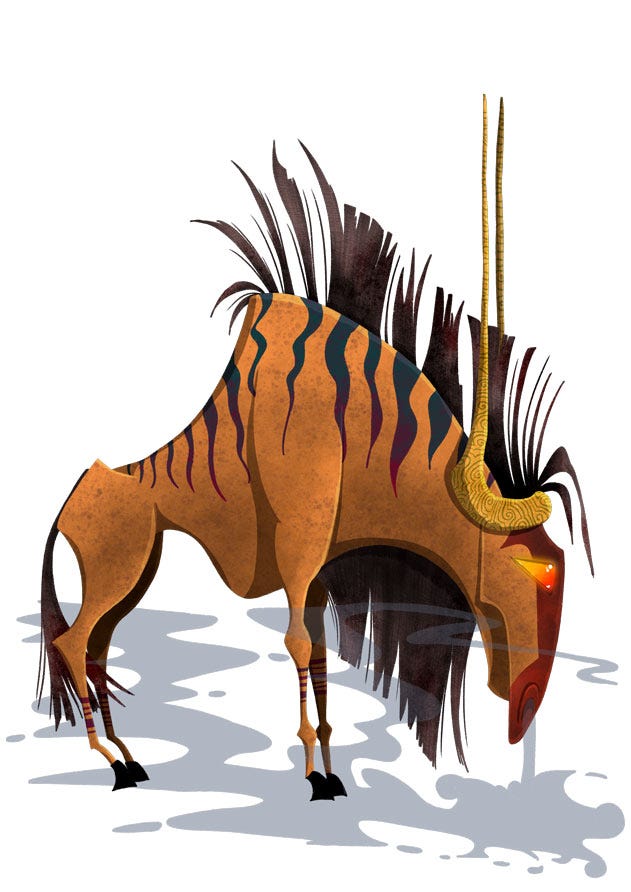
Beware, for this magnificent marvel of nature must never be met eye to eye, and under no circumstance should it be approached, as pernicious and poisonous peril lurks within its presence.
Size: A bulky bull
Lifespan: A long-living bull
Habitat: The Roof of Africa
Diet: Venomous plants
Behind The Legend
In times when the world was vast, mysterious, and fraught with challenges and strange creatures, many adventurers and intrepid conquerors ventured into the unknown, hoping for a better and different life. Promising riches beyond familiar horizons, the distant lands were a tempting yet perilous invitation for those willing to overcome their fears in pursuit of coveted treasures. Amidst this backdrop, chronicles and travelers' tales breathed life into ancient and medieval bestiaries, describing incredible animals and fantastical beings alongside the landscapes they inhabited. One such curious creature is the Catoblepas.
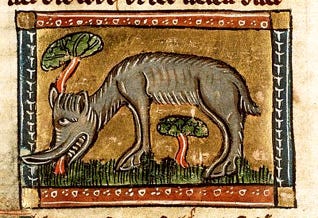
Its history can be traced back to the Romans. The earliest known mention of this creature comes from Pliny the Elder in his Naturalis Historia. Pliny was a remarkable thinker and naturalist who, unfortunately, perished in 79 AD during the eruption of Mount Vesuvius. He ventured too close to the coast with his ship and was engulfed by toxic gases. During my high school Latin studies, we delved into some of his works, which proved to be truly fascinating.
Pliny wrote:
“Among the Hesperian Æthiopians is the fountain of Nigris, by many, supposed to be the head of the Nile. I have already mentioned the arguments by which this opinion is supported.1 Near this fountain, there is found a wild beast, which is called the catoblepas; an animal of moderate size, and in other respects sluggish in the movement of the rest of its limbs; its head is remarkably heavy, and it only carries it with the greatest difficulty, being always bent down towards the earth. Were it not for this circumstance, it would prove the destruction of the human race; for all who behold its eyes, fall dead upon the spot.”
“Apud Hesperios Aethiopas fons est Nigris, ut plerique existimavere, Nili caput, ut argumenta quae diximus persuadent. iuxta hunc fera appellatur catoblepas, modica alioqui ceterisque membris iners, caput tantum praegrave aegre ferens — id deiectum semper in terram —, alias internicio humani generis, omnibus, qui oculos eius videre, confestim expirantibus.” (Naturalis Historia , Book 8, chapter 32)
But the legend of this beast predates Pliny's account; the name Catobleplas originates from the ancient Greek word καταβλέπω, meaning "to look downwards".
The Naturalis Historia was so successful that it was continually copied and quoted as a scientific source for centuries, from Bede the Venerable to the late 1500s when Ulisse Aldrovandi, a renowned Italian naturalist recognized by Carl Linnaeus as the father of natural history studies, produced his monumental Theatre of Natural History. With each retelling, new extravagant details were added, contributing to the fame and legend of the Catoblepas.
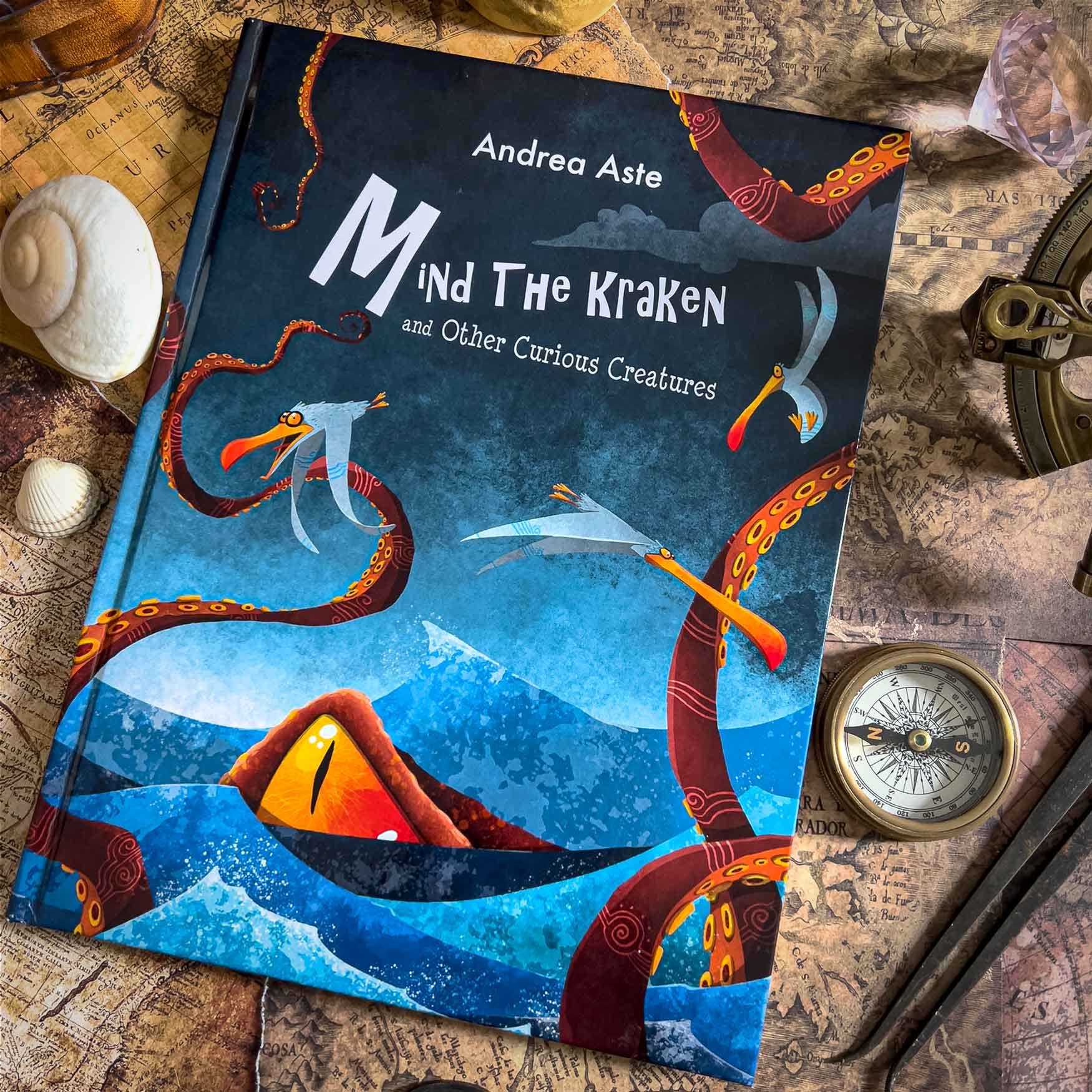
From Mind The Kraken and Other Curious Creatures
(if you are curious, and I hope you are, please have a look at the book, click here)
Have a splendiferous day
Andrea Aste
Cute but I don’t think I’d like to have it as a pet!
Quite interesting that one creature can be so calm and so devastating at the same time!
For those who have not read The Kraken, taking the time to check it out is well worth your while!